
Cold work tool steel with 2% Carbon and 12% Chromium with very high wear resistance
2080 PRIME is a high-alloyed, air-hardenable, cold-worked steel with 2%C and 12% Cr. 2080 PRIME has very high wear resistance associated with high hardness.
Applications
2080 PRIME can be used for the manufacture of cutting and punching tools up to 4 mm thick and also tools for machining wood.
2080 PRIME can also be used for the production of shear blades for metal plates up to 2 mm thick and also for paper, wood and reinforced plastics.
2080 PRIME is also used for all kind of parts in contact with highly abrasive materials as porcelain.
2080 PRIME can also be used for abrasive plastics molding tools and also for guiding parts.
Main properties
- Excellent wear resistance
- High hardness
- High compressive strength
- Simple heat treatment with a very slight change in size
- High hardenability
Chemical composition (typical)
| C | Mn | Si | P | S | Cr |
|---|---|---|---|---|---|
| 2.00 | 0.30 | 0.30 | ≤ 0.030 | ≤ 0.005 | 12.0 |
Designation
| Werkstoff Nr | ISO | China GB | JIS Japan | UK | AISI USA | Russia Gost | AFNOR | Other / Special |
|---|---|---|---|---|---|---|---|---|
| 1.2080 | X210Cr12 | Cr12 | SKD1 | BD3 | D3 | – | – | – |
Structure
The structure of the 2080 PRIME is fine and homogeneous without precipitation or alignments of big carbides. Never the less the 2080 PRIME has a low toughness because of it composition leading to an important quantity of carbides ensuring a high wear resistance and hardness.
Hardness at the time of delivery
Annealed for 250 HB max.
Physical properties
| Temperature | 20°C | 300°C | 600°C |
|---|---|---|---|
| Volumic mass kg/m³ | 7670 | 7650 | – |
| Young Modulus N/mm² | 210000 | 192000 | – |
| Thermal conductivity W/m.K | 19.7 | 20.9 | 24.5 |
| Coefficient of linear expansion 10-6/K | 10.8 | 12.6 | 13.3 |
Heat treatment
Soft annealing
Temperature: 810 – 820°C, duration 1h + 1h for 25 mm thickness. Slow cooling in the furnace (10 to 20°C/h). The atmosphere in the furnace must be reducing to avoid decarburization of the steel.
Stress relieving
After machining, it is recommended to perform stress relieving at 600 – 650°C for a minimum of 2 hours, followed by slow cooling in the furnace to 450°C.
Austenitization
In order to avoid any risk of cracking it is recommended to preheat in 1 step.
- 1st preheating step: temperature: 600°C time: 30 s/mm of thickness
Recommended austenitizing temperature: 930 – 960°C. The holding time should not be too long to avoid a risk of grain coarsening and a loss of toughness. It is recommended to keep the part at the austenitizing temperature 30 minutes per inch of thickness as soon as the temperature of the surface reach the austenitization temperature.
Sub zero treatment
For parts that need to have high dimensional stability and to increase wear resistance without reducing toughness, it is recommended to perform a subzero treatment at a temperature between -70°C and -190°C for 1 hour for 25 mm of thickness of the part.
The temperature range from -70°C up to -120°C (named cold treatment of steel) leads to the complete transformation of austenite into martensite and as a consequence to better stability associated with improved hardness and better wear resistance and the temperature range from -135°C down to -190°C (named cryotreatment of steel) leads also to the complete transformation of austenite and also the precipitation of ultrafine carbides improving a lot the wear resistance without modification of the toughness. This treatment is optional for common applications.
Quenching medium
Oil at 80°C, vacuum (pressure > 6 bars), salt bath 500 – 550°C.
To ensure good toughness, treatment with oil or salt bath is preferable.
After quenching the hardness is 63 – 65 HRC.
Tempering
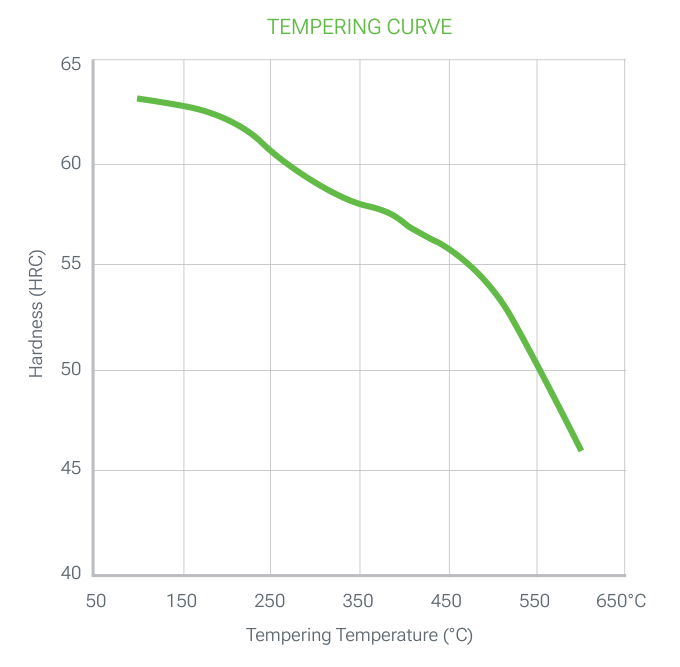
To ensure a minimum residual austenite rate as well as greater tool stability, it is essential to perform a double (triple is better) tempering. Each tempering is followed by a cooling under 100°C. Each tempering time must be at least equal to 1h + 1h for 25 mm of thickness of the treated part (equivalent thermal thickness). The usual hardnesses for cold working applications are in the range of 57 to 62 HRC.
Surface treatment
PVD, CVD
2080 PRIME is suitable for all kinds of PVD and CVD treatment as soon as the treatment temperature is 30°C lower than the last tempering temperature.
Polishing
2080 PRIME could be polished the treated state and can be used for applications requiring a sufficiently polish level for translucent parts.
Optimal polishing is achieved by performing consecutive steps of fairly close roughness and stopping each step as soon as the last scratch of the previous step disappears.
Machining
The machining parameters below are given for information only and must be adapted according to the equipment and usual machining conditions.
Turning
| Carbide tool Rough machining |
Carbide tool Finishing |
HSS tool Finishing |
|
|---|---|---|---|
| Cutting speed m/min | 100 – 150 | 140 – 200 | 10 – 15 |
| Feed mm/r | 0.2 – 0.4 | 0.1 – 0.2 | 0.1 – 0.3 |
| Depth of cut mm | 2 – 4 | 0.5 – 2 | 0.5 – 2 |
Milling: surfacing
| Milling with carbide tools Rough machining |
Milling with carbide tools ½ Finishing |
Solid tool Finishing |
|
|---|---|---|---|
| Cutting speed m/min | 100 – 120 | 160 – 180 | 80 – 100 |
| Feed mm/r | 0.2 – 0.4 | 0.1 – 0.2 | 0.02 – 0.2 |
| Depth of cut mm | 2 – 4 | 0.5 – 2 |
Drilling: HSS twist drill
| Drill diameter mm | Cutting speed m/min | Feed mm/t |
|---|---|---|
| < 5 | 10 – 12 | 0.05 – 0.15 |
| 5 – 10 | 10 – 12 | 0.15 – 0.20 |
| 10 – 15 | 10 – 12 | 0.20 – 0.25 |
| 15 – 20 | 10 – 12 | 0.25 – 0.30 |
Drilling: carbide drill
| Carbide type | Indexable insert | Solid carbide | Carbide tip |
|---|---|---|---|
| Cutting speed m/min | 130 – 150 | 80 – 90 | 35 – 45 |
| Feed mm/t | 0.05 – 0.10 | 0.10 – 0.25 | 0.15 – 0.25 |
Fine grinding
General indications for grinding wheels to be used on 2080 PRIME in the heat treated condition
Usually, rather soft vitrified aluminum oxide grinding wheels (grades G for plane grinding to K for cylindrical grinding) are used.
Particular attention will be paid to effective cooling of the surface during grinding to prevent degradation of the material surface.
Electro-discharge machining
2080 PRIME is not recommended for electro discharge machining. The alternative consists in using 2379 PRIME or 8% Cr steels with stress relieving after the EDM.
Welding
2080 PRIME cannot be welded.
Download the 2080 PRIME datasheet (PDF)
More grades: Cold Work Tool Steels. Where to buy: Service Network.
